


JCB's Hydrogen Missile Breaks the 400mph Barrier


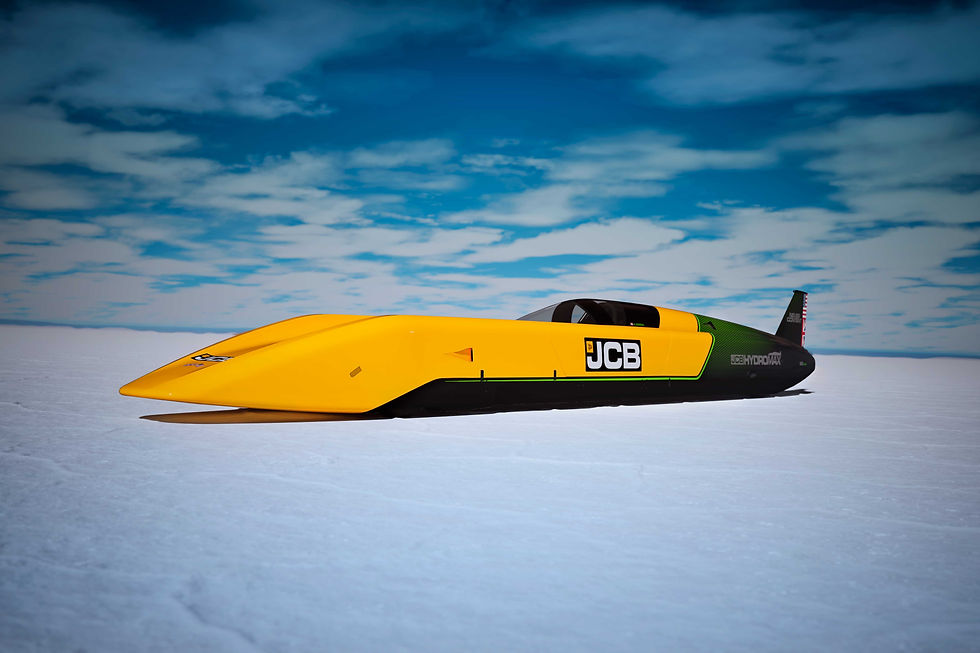
The British construction giant has just turned heads around the world after its hydrogen-powered Hydromax smashed the hydrogen land speed record at Utah's famous Bonneville Salt Flats.
The astonishing run saw the Hydromax reach an average speed of 406.320mph (653.9km/h), making it the fastest hydrogen-powered vehicle ever recorded.
Driven by former RAF pilot and land-speed legend Andy Green, the car completed two official runs in opposite directions, as required by FIA rules, recording speeds of 400.623mph and 412.135mph.
Unlike many hydrogen demonstrators that rely on fuel cells and electric motors, the Hydromax uses two hydrogen combustion engines derived from technology already being developed for JCB's construction equipment.
Together, the engines produce around 1,600 horsepower, but their real significance lies elsewhere.
They are based on production-ready powertrains designed for real-world machinery rather than purpose-built racing engines.
That distinction matters because one of the biggest debates facing the construction industry is how heavy machinery will be powered in the decades ahead.
Battery-electric equipment works well in some circumstances, but the challenges of charging large machines on remote sites remain significant.
Hydrogen combustion offers another route, providing the familiarity of an internal combustion engine while reducing carbon emissions at the point of use.
The Hydromax record therefore feels like much more than a motorsport headline. It's a giant rolling advertisement for a technology that JCB believes could help decarbonise excavators, loaders and other heavy-duty equipment.
By taking the same type of engine intended for construction machinery and pushing it beyond 400mph, the company has created a dramatic demonstration of what hydrogen combustion is capable of achieving.
There's also a pleasing sense of history repeating itself. Twenty years ago, Andy Green drove JCB's diesel-powered Dieselmax to a world speed record at the same location.
That achievement showcased the performance potential of diesel technology. Now, two decades later, Green has returned to Bonneville to set another benchmark, this time with hydrogen power.
The Hydromax not only surpassed the previous hydrogen combustion record of 185.5mph but also eclipsed JCB's own diesel benchmark.
Of course, construction companies won't be seeing 400mph excavators on site anytime soon.
But that's not really the point. Record-breaking projects have long been used to prove technology in extreme conditions before it filters into everyday applications.
Racing improved tyres, brakes and engine efficiency long before those advances became standard on road-going vehicles. JCB is hoping the same principle will apply to hydrogen-powered machinery.
Whether hydrogen ultimately becomes a mainstream fuel for construction equipment remains to be seen.
What is already clear, however, is that JCB has succeeded in grabbing attention. After all, it's hard to ignore a vehicle powered by technology from a digger that has just blasted past 400 miles per hour in the Utah desert.


Comments