


JCB’s New Hydrogen Car Set to Shatter a 350 MPH World Record

It’s not every day you hear about a construction company trying to build one of the fastest vehicles on the planet.
After all, JCB is best known for diggers, not drag races.
But in a bold move that feels equal parts engineering showcase and high-speed spectacle, the British manufacturer is gearing up to send a hydrogen-powered car hurtling across a salt flat at speeds of more than 350 miles per hour.
JCB is heading back to the Bonneville Salt Flats in Utah—a place synonymous with land speed records—for another crack at the history books.
It’s not their first time either. Nearly two decades ago, the company stunned the world by setting a diesel-powered speed record of just over 350 mph—a figure that still stands today.
Now, they’re back, aiming not just to repeat history, but to rewrite it completely—with hydrogen.
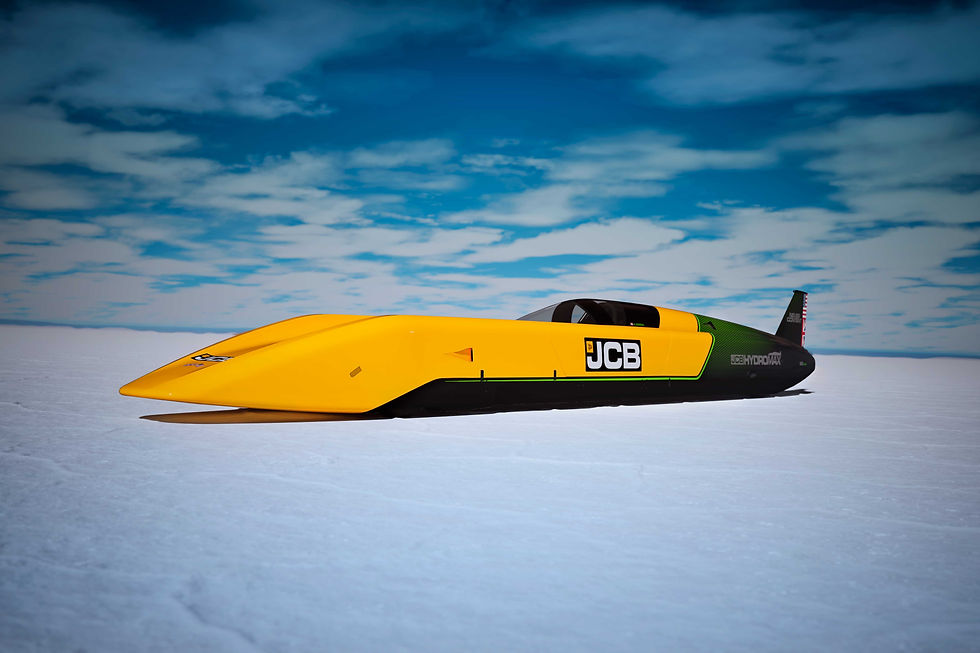
At the centre of the story is the JCB Hydromax, a 32-foot-long, ultra-sleek machine that looks far closer to a rocket than anything you’d find on a motorway.
But it’s what’s under the bonnet that really matters.
Instead of diesel or batteries, this beast runs on two hydrogen combustion engines, each producing around 800 horsepower—giving a combined output of roughly 1,600 hp.
That’s serious power by any standard.
And crucially, it’s not experimental tech built only for the record attempt. These engines are based on the same hydrogen technology JCB is already developing for real-world machinery.
In other words, this isn’t just about speed—it’s about proving a point.
Behind the wheel is someone who knows a thing or two about going very, very fast.
Andy Green—the only person ever to break the sound barrier on land—will be the one steering the Hydromax.
He’s no stranger to JCB either. He was the driver who piloted their diesel car to that 350 mph record back in 2006.
And if anyone’s going to push a hydrogen-powered machine to extreme speeds, it’s probably him.
The headline figure—350 mph—isn’t random.
That’s the benchmark JCB is chasing and beating it would be a major milestone.
The current records for hydrogen-powered vehicles are significantly lower. Some have reached just over 300 mph, while hydrogen combustion cars have historically gone much slower.
If the Hydromax hits its goal, it won’t just break a record—it could completely reset expectations.
On the surface, this is a story about speed. But dig a little deeper, and it becomes something more.
JCB has spent years—and a reported £100 million—developing hydrogen engines as an alternative to more traditional fuels.
Instead of launching that technology quietly, they’re doing what they did before: putting it in the most extreme environment possible and letting it speak for itself.
Because a digger might not grab headlines, but a car doing 350 mph certainly does.
There’s also something undeniably theatrical about the whole thing.
A 32-foot hydrogen-powered machine, built to slice through desert air at aircraft-like speeds, driven by one of the fastest people alive… it’s hard not to see the drama in that.
Every detail—from aerodynamics to traction—has been designed with one purpose: keeping the car stable while it travels at speeds most people can barely comprehend.
At 350 mph, even the smallest miscalculation matters.
JCB has done this before—just with a different fuel.
And with the same driver, the same location, and arguably even more advanced engineering, there’s a sense that this isn’t just a publicity stunt.
It’s a serious attempt to do something genuinely remarkable.
Whether they succeed or not, one thing’s certain: this isn’t your typical motoring story.
It’s about pushing technology to its limits, turning something as unlikely as a construction equipment manufacturer into a contender for one of the fastest machines ever built.


Comments